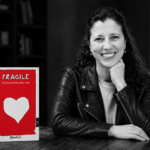





Some books ask to be read from beginning to end. Others ask the reader to pause, look again and listen to what happens between the words. Özlem Aliyazıcıoğlu Yeni’s Fragile belongs to the second category.
Published by Banliyö Kitap, Fragile is a 146-page collection of poems accompanied by the author’s own drawings. It is a book about migration, distance, love and self-discovery, but it is also an experiment in how a feeling can move between language and image.
A Practice Shaped by Movement
Yeni comes to poetry with a long and varied background in the arts. Trained in painting, she later completed postgraduate research in stage design and spent many years in academia. Her work has extended across visual art, curation, art direction, stage design and costume design, with exhibitions and artistic activity connected to Türkiye, Japan, Australia, and the USA.
Her experience of living and working between countries is important to the atmosphere of Fragile. The book was shaped during a period in Australia when the author’s life was being stretched between places, relationships and languages. This sense of movement gives the collection its emotional geography.
Poetry as a Place of Belonging
In Fragile, migration is not treated as a simple story of departure and arrival. Instead, it becomes an ongoing question: what happens to identity when home is no longer a single, stable place?
The poems return to houses, doors, roads, roots, skies and shorelines. These images create a vocabulary of belonging. A house may offer shelter, but it may also contain an unfinished story. A road may promise freedom, but it can also expose how uncertain the next step remains.
The speaker in these poems is often situated between two versions of the self. There is the person who left, the person who stayed behind and the person still being formed somewhere in between. This gives the collection a quiet but persistent tension.

The Emotional Architecture of Distance
Love is another central force in the book. Yet it is rarely presented as a simple resolution. Love appears through absence, waiting, memory and the desire to close a distance that cannot always be crossed immediately.
Yeni’s poems are often brief, but their brevity is deliberate. Rather than explaining every emotion, they leave room for the reader’s own memories. A few lines can hold the weight of a letter, a missed conversation or the sudden return of an old feeling.
The result is a form of intimacy that does not depend on confession alone. The poems speak personally, but they remain open enough for the reader to enter them.
When the Page Becomes Part of the Poem
The visual design of Fragile is central to its meaning. Lines are sometimes arranged conventionally, then suddenly broken apart. Individual words may stand alone. A generous field of white space may become as expressive as the text itself.
These choices make reading a physical experience. The eye slows down. Silence becomes visible. The reader begins to notice not only what the poem says but also how much space it needs in order to say it.
This is where Yeni’s background in visual art becomes especially evident. The page is not treated as a neutral surface. It becomes a stage on which words, gaps and marks interact.
Drawings That Refuse to Explain
The drawings in Fragile do not simply illustrate the poems. They do not offer a fixed visual translation of the text. Instead, they create a parallel language.
A line or shape may echo the mood of a poem without defining it. At times, the drawings feel like traces left behind by the writing process itself: fragments, gestures and quiet signs that continue the emotional movement of the words.
This relationship between poetry and drawing is one of the book’s most distinctive qualities. Neither medium dominates the other. The poems do not need the drawings in order to be understood, and the drawings do not merely serve the poems. Together, they form a more spacious and layered reading experience.
Fragility as Transformation
Although the book begins in the territory of distance, uncertainty and vulnerability, its emotional direction gradually changes. The search for the self becomes an act of acceptance. The fear of change gives way to the possibility of becoming someone new.
That movement is contained in the title. “Fragile” may suggest something easily damaged, but in Yeni’s work it also describes a state of heightened awareness: the ability to feel deeply, to recognise one’s own wounds and to remain open to transformation.
By the final pages, fragility has begun to look less like weakness and more like the beginning of flight.

A Book Between Forms
Fragile occupies an interesting space between poetry collection, artist’s book and visual diary. Its concerns are intimate, but its form is carefully considered. It asks the reader to move between words and images, between what is expressed and what is withheld.
For readers interested in contemporary poetry, visual storytelling and the emotional experience of migration, Özlem Aliyazıcıoğlu Yeni’s book offers a thoughtful and quietly affecting encounter. It is a collection about leaving and remaining, about loving across distance and about learning that the way back to oneself may begin with becoming lost.